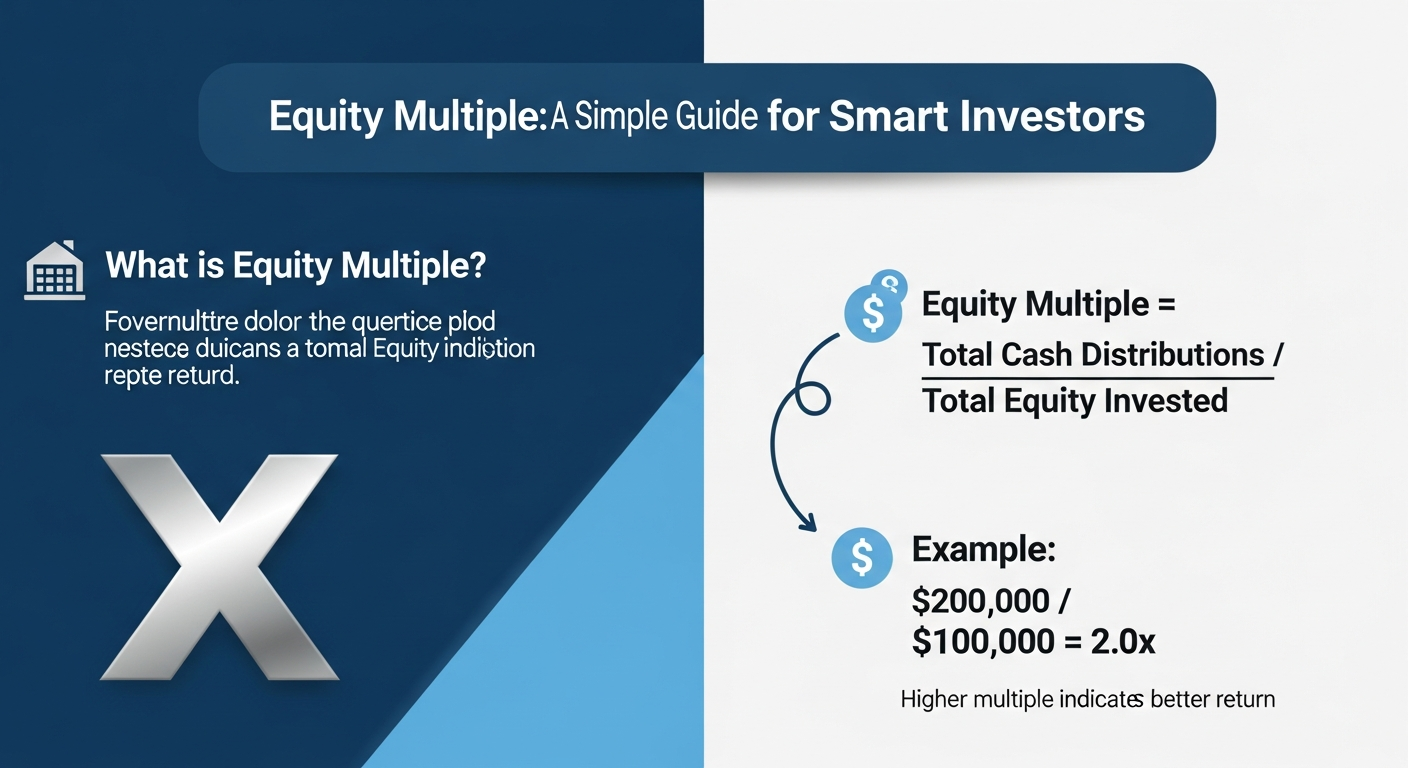
If you’re new to investing or real estate, you might have heard the term equity multiple and wondered what it means. Simply put, equity multiple shows how much money you make compared to what you invested. It tells you how many times your original investment will grow over time.
For example, if you put $1,000 into a project and your equity multiple is 2, that means you will get back $2,000 in total. This number includes your original money plus the profit you earned. Equity multiple helps investors like you and me quickly understand the success of an investment.
In this article, we will explore everything about equity multiple in simple words. You’ll also find helpful tips and answers to common questions. Let’s dive in!
What is Equity Multiple?
Equity multiple is a way to measure how much money you earn from an investment compared to the amount you put in. It is a ratio that shows your total cash returns divided by your original investment. If your equity multiple is 1, you only get your money back with no profit. A number higher than 1 means you earned money.
Investors use equity multiple to see if an investment is good or not. It helps compare different opportunities to find the best one. This number is easy to understand and very useful in real estate, stocks, and other investments.
How to Calculate Equity Multiple
To calculate equity multiple, you add up all the money you get from the investment, including profits and original money, then divide it by how much you invested.
Formula:
Equity Multiple = Total Cash Received ÷ Total Cash Invested
For example, if you invested $5,000 and received $15,000 back, your equity multiple is 3. This means you tripled your money.
Why is Equity Multiple Important?
Equity multiple is important because it gives a clear picture of how well your investment is performing. Unlike other metrics, it shows the total return on investment, not just annual profits. This helps investors understand the full value of their investment.
It also helps compare different investments quickly. If one project has an equity multiple of 2.5 and another has 1.8, you know which one gave more total return.
Equity Multiple vs. ROI: What’s the Difference?
Equity multiple and ROI (Return on Investment) both measure investment performance, but they are different.
- Equity multiple shows the total money returned divided by the money invested.
- ROI usually shows the percentage gain or loss over a specific period.
Equity multiple is a simple ratio, while ROI is a percentage and often annualized. Both are useful but serve different purposes.
Real-Life Example of Equity Multiple
Imagine you invest $10,000 in a rental property. Over 5 years, you get $12,000 from rent and $8,000 when you sell the property. Total cash received is $20,000.
Your equity multiple is:
$20,000 ÷ $10,000 = 2.0
This means you doubled your investment in 5 years.
Equity Multiple in Real Estate
In real estate, equity multiple helps investors understand the total cash returns from properties. It includes rental income plus money from selling the property. Real estate deals usually take years, so this measure shows how much money an investor will make in total.
Equity Multiple and Cash on Cash Return
Cash on cash return looks at yearly profits compared to your invested cash, while equity multiple looks at total returns over time. Both are important but tell different stories. Equity multiple shows the full picture of investment gains.
Benefits of Using Equity Multiple
- Easy to understand
- Shows total return, not just yearly profits
- Helps compare different investments
- Useful in real estate, stocks, and private equity
- Helps investors make better decisions
Limitations of Equity Multiple
While useful, equity multiple doesn’t show when you get your money back. For example, two investments might have the same equity multiple, but one pays you faster. To know that, you should also look at metrics like Internal Rate of Return (IRR).
How to Use Equity Multiple for Better Investing
Use equity multiple to quickly check if an investment is worthwhile. Look for projects with an equity multiple higher than 1.5 for good returns. Also, combine it with other numbers like IRR or cash on cash return to get a full picture.
Common Mistakes to Avoid
- Relying only on equity multiple without other data
- Ignoring the time it takes to get your money back
- Confusing equity multiple with ROI
- Using equity multiple alone for quick decisions
Frequently Asked Questions (FAQs)
1. What does an equity multiple of 1 mean?
An equity multiple of 1 means you got back exactly what you invested, with no profit or loss.
2. Is a higher equity multiple always better?
Usually, yes. A higher equity multiple means you made more money. But also consider how long it took to get that return.
3. Can equity multiple be less than 1?
Yes, if you lose money on an investment, your equity multiple will be less than 1.
4. How is equity multiple different from IRR?
Equity multiple shows total return, while IRR accounts for the timing of returns, showing annual growth rate.
5. Is equity multiple used only in real estate?
No, it’s used in many investments like stocks, businesses, and private equity.
6. How can I improve my equity multiple?
Invest in projects with strong cash flow and growth potential. Also, reduce costs and manage risks carefully.
Conclusion
Understanding equity multiple is a smart way to see how your investments grow over time. It’s simple to calculate and helps you compare deals easily. Remember to look at other numbers like IRR for a full picture. Use equity multiple as one of your tools to become a confident and smart investor.